
Updated: August 07, 2025
Reading Time: 4 Min
Written by: The Zoe Team
While both market timing and time in the market are popular terms among investors, their approaches, and outcomes, are strikingly different.
Many investors want to know: Is market timing a sound investment strategy, or is it better to stay invested for the long term? Blackrock’s Historical data shows that over the past century, staying invested—‘time in the market’—has outperformed active attempts to predict market swings. In this guide, Zoe Financial breaks down important considerations to know, and how to make decisions to help support your financial goals.
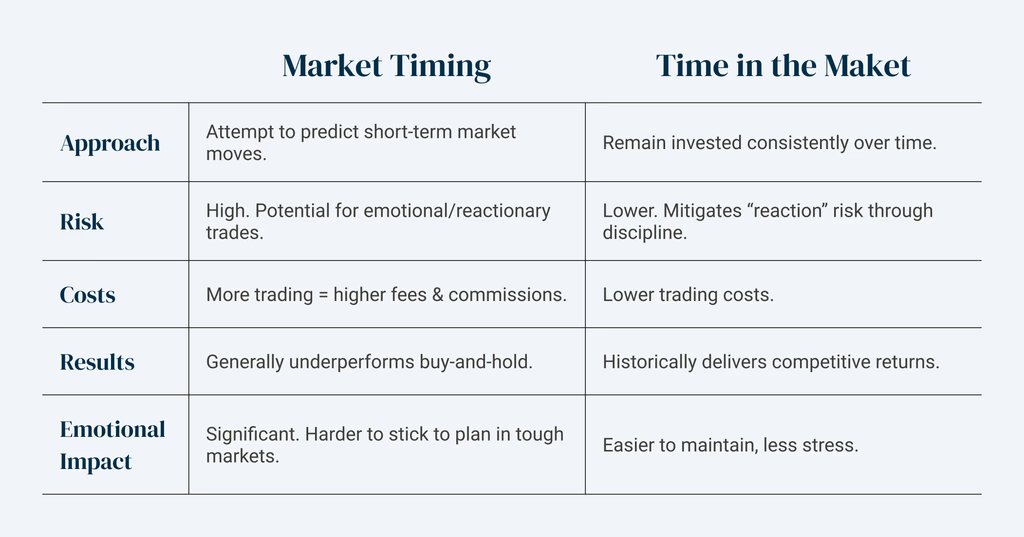
Market timing is an investment strategy where investors attempt to predict future market movements and buy or sell investments based on those predictions. This approach can feel appealing, but the reality is that accurately and consistently forecasting market moves is extremely difficult, even for professionals. Even major investment firms advise against market timing—missing a few top market days can cut annualized returns dramatically.
Risk: Emotional, short-term decisions often lead to buying or selling at the wrong times.
Costs: Frequent trading increases transaction costs, which can eat into returns (learn more about investment types).
Performance: Research proves professional market timers consistently underperform compared to those who buy and hold over time.
Time in the market means staying invested for the long term, regardless of short-term market swings. This approach relies on the well-established principle that financial markets tend to rise over time, despite periodic downturns.
Evidence: From 1950–2017, five-year investment horizons for the S&P 500 saw much smaller negative ranges (down 3% to up 28%), compared to one-year horizons that could swing from +47% to -39%. Capital Group even highlights that every 10‑year period since the 1940s has delivered positive returns in the S&P 500.
Behavior Gap: Emotional reactions to volatility can lead to poor market-timing decisions (see why diversification is essential).
Long-Term Growth: A diversified portfolio held for several years often delivers better results than attempting to beat the market in the short-term.
The answer for most investors is: probably not. Studies and Zoe Financial experts agree that the risk and cost of market timing outweigh the potential rewards for the average investor. Instead:
Set clear, long-term financial goals
Develop a disciplined investment plan based on sound asset allocation
Diversify across asset classes
Stay the course, adjusting your plan only as your needs or objectives evolve
If you’re unsure about your approach, it can help to find a vetted investment advisor through Zoe Financial.
The Zoe Team is committed to empowering investors through education, transparency, and data-driven advice. Zoe Financial connects you to top fiduciary financial advisors—so you can invest with confidence, today and for the long term.